


Vulnerability of homeless people increases with covid-19
- Glocal

- Mar 26, 2020
- 2 min read
In response to the current health crisis caused by covid-19, governments around the world have called, as part of their infection prevention measures, for people to stay at home to avoid spreading the virus. But what about those who have no home in which to take refuge in the face of this pandemic?
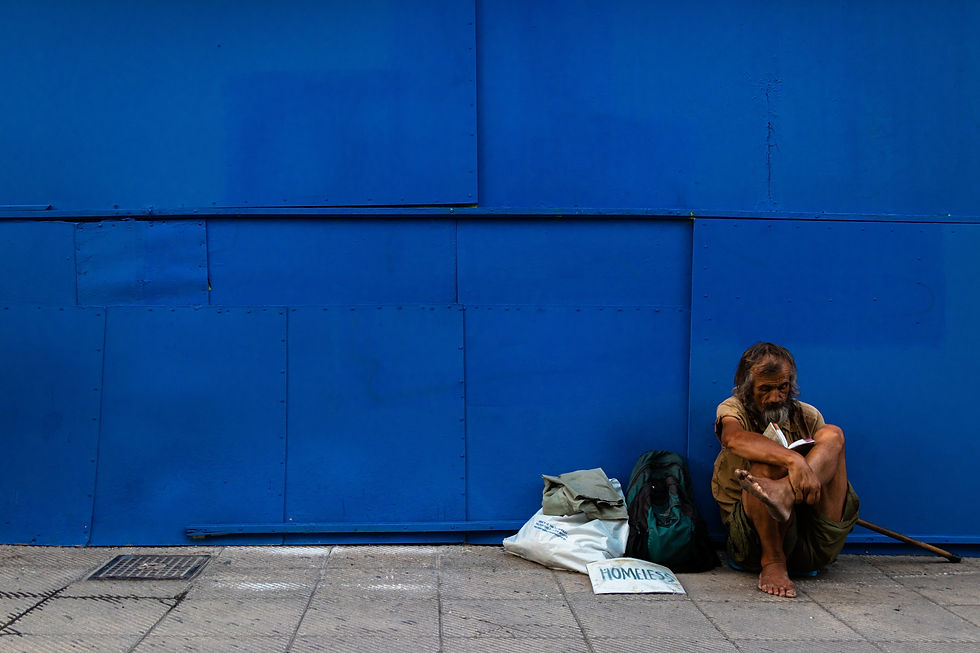
Image: Unsplash
According to the World Economic Forum, the number of homeless people is estimated to be approximately 150 million around the world, or 2% of the world's population. For them, access to basic resources such as water and food is a daily challenge that is growing even more now that hygiene products such as alcohol gels and disinfectant soap are becoming as indispensable to survival as water and food.
In Guatemala, it is estimated that around 40,000 men, women, children and migrants live on the streets. In response to the health crisis, two warehouses were set up in the city to serve as shelters for these people. However, the capacity they cover is only 84 people, which means that only 0.2% of this group is being attended to.

Image: Unsplash
But the vulnerability of these groups transcends borders. In Spain, the second country in the world with the most deaths per covid-19 so far, there are around 31 thousand homeless people. To accommodate them, the country has set up shelters in cities such as Madrid and Barcelona, which are also unable to cope with all of them.
Throughout the United States, more than half a million people are homeless. Most of them are sleeping in shelters and transitional housing. The state of Los Angeles is home to one of the largest populations of homeless people in the United States. "Social distance is a luxury that homeless people cannot afford," said Shirley Raines, founder of Beauty 2 The Streetz, a nonprofit organization that serves homeless people in that region. "There are 60,000 homeless people in L.A. who have nowhere to go", she said in an interview with ABC News.

Graphic: Our World In Data
The same message applies to this vulnerable group of the global population. That's why it's important to make those people's needs visible and address them immediately. This is what is being done in regions like Glasglow, United Kingdom, where the municipality has used empty apartments to provide temporary shelter to allow this sector to take care of outbreaks of coronavirus and to isolate themselves if they show symptoms. In these spaces people can wash their hands constantly, something impossible for those who sleep on the streets.

Image: Unsplash
Similarly, in San Francisco, United States, the local government has leased trailers and hotel rooms to quarantine homeless people who show signs of infection. In Londrina, Brazil, the Catholic Church converted three of its spaces into shelters with the capacity to receive 50 people each, and in Buenos Aires, Argentina, sports centers were set up and used as shelters during the winter to provide shelter for this sector of the population. (Nómada, 2020).


Comments